previous
8 Must-Visit Walking Streets and Markets in Khon Kaen

Investing in a rental condominium remains one of the most popular ways to generate passive income in Thailand. However, simply purchasing a condo because it is in a “good location” or comes with an attractive price tag is no longer enough. Today’s investors need to evaluate rental demand, expected returns, hidden ownership costs, taxes, and tenant behavior before making an informed decision.
In this guide, Ocean Property explores whether condo rental investment is still profitable in 2026, how to calculate Rental Yield, which unit types are easiest to lease, and what factors contribute to stable long-term cash flow. Whether you’re a first-time investor or looking to expand your property portfolio, this article will help you make smarter investment decisions.
Key Takeaways

Thailand’s condominium market in 2026 is increasingly driven by real rental demand rather than speculative buying. While locations near Bangkok’s mass transit lines have traditionally been favored by investors, rising property prices in many prime districts have compressed rental yields. At the same time, several mid-market condominium projects are facing stronger competition due to increasing supply.
As a result, many investors are shifting their focus toward regional cities where rental demand is supported by actual residents rather than speculative buyers. University students, healthcare professionals, government employees, and local business workers represent tenant groups with stable, year-round housing needs.
Among these cities, Khon Kaen has become one of Thailand’s most attractive emerging property markets. As the economic, educational, and healthcare hub of Northeastern Thailand, the city benefits from continuous demand generated by Khon Kaen University, major hospitals, and expanding public and private investment. The university alone brings tens of thousands of students, faculty members, researchers, and staff into the city each year, creating a healthy and active rental market.
This growing demand explains why many investors are turning their attention to low-rise condominiums located near universities and city centers. Compared with high-rise developments in Bangkok, these projects often offer a lower entry price while maintaining strong long-term rental potential and sustainable cash flow.
Like every investment, rental condominiums offer both opportunities and risks. Understanding both sides helps investors make better long-term decisions.
Benefits of Investing in Rental Condominiums
Risks Every Condo Investor Should Consider
A practical rule of thumb is to ensure your finances can comfortably support the property even if it remains vacant for three to six months. Having sufficient cash reserves helps protect your investment during slower rental periods.
When the right location, tenant demand, and financial planning come together, a rental condominium can generate consistent cash flow while building long-term wealth through both rental income and capital appreciation.
When evaluating whether a condominium is a worthwhile investment, experienced investors focus on Rental Yield rather than monthly rental income alone. Rental Yield provides a clearer picture of how effectively a property generates returns relative to its purchase price.
How to Calculate Gross Rental Yield
The most common formula is:
Gross Rental Yield = (Annual Rental Income ÷ Property Purchase Price) × 100
In general, a Gross Rental Yield of 6–8% or higher is regarded as competitive in Thailand’s condominium market, particularly in locations with strong and sustainable rental demand.
How to Calculate Cash-on-Cash Return
If you finance your purchase with a mortgage, it’s equally important to calculate your return based on the actual cash you’ve invested.
Cash-on-Cash Return = (Net Annual Cash Flow ÷ Total Initial Cash Investment) × 100
Net Annual Cash Flow should include rental income after deducting operating expenses, mortgage repayments, maintenance costs, taxes, insurance, and other ownership expenses.
Unlike Gross Rental Yield, Cash-on-Cash Return provides a more realistic view of your investment performance by showing how efficiently your own capital is generating returns.
One of the most common questions among first-time investors is:
“Where is the best place to buy a condo that is easy to rent out?”
The answer depends on one key factor: consistent tenant demand.
Locations Near Public Transportation and Business Districts
Condominiums close to public transportation, central business districts (CBDs), and major office complexes continue to attract office workers who value shorter commuting times.
Properties in these locations typically experience stable rental demand, although they often require a higher initial investment.
University Districts
University neighborhoods remain one of the strongest rental markets in Thailand. Large universities generate continuous demand from:
This creates a reliable tenant base throughout the academic year and often results in lower vacancy rates compared to many other residential markets.
Emerging Growth Areas
Cities and neighborhoods undergoing infrastructure development—such as new highways, public transportation systems, mixed-use developments, or major commercial projects—often present excellent long-term investment opportunities.
Buying early in these locations may provide both rental income and future capital appreciation as the area continues to develop.
Not every unit type performs equally in the rental market. Choosing a property that matches tenant demand is one of the most important factors influencing occupancy rates.
Studio and One-Bedroom Units Remain the Most Popular
Young professionals, university students, and first-time employees typically look for practical living spaces with affordable monthly rents. As a result, Studio and One-Bedroom units continue to be among the easiest condominium types to rent.
Choose a Fully Furnished Unit
Move-in-ready units are generally more attractive to tenants because they reduce both moving costs and setup time. A fully furnished condominium typically allows tenants to move in immediately, increasing your property’s competitiveness while reducing vacancy periods.
Don’t Buy Based on Personal Preference
One of the biggest mistakes new investors make is choosing a condominium they personally like rather than one that suits their target tenants.
Instead, start by identifying your intended renter profile and select a unit that matches their lifestyle, budget, and everyday needs. Investment decisions should always be driven by market demand rather than personal taste.
Monthly mortgage payments are only one part of the total investment cost. Many first-time investors underestimate the ongoing expenses associated with owning a rental property.
Common hidden costs include:
Failing to account for these expenses can significantly reduce your actual investment returns. Building these costs into your financial projections before purchasing a property will provide a far more accurate estimate of your long-term profitability.
Owning a rental condominium involves more than just collecting monthly rent. Investors should understand the taxes and transaction costs associated with property ownership to accurately estimate long-term returns.
Land and Building Tax
Condominiums used as rental properties are generally classified as investment assets and are subject to Thailand’s Land and Building Tax under residential property tax rates.
Tax rates vary depending on government regulations and property value, but they typically start from approximately 0.02% for residential properties.
Personal Income Tax on Rental Income
Rental income earned from leasing a condominium is considered assessable income under Section 40(5) of the Thai Revenue Code and must be included in your annual personal income tax filing.
Investors should maintain proper records of rental income and deductible expenses to ensure accurate tax reporting.
Ownership Transfer Costs
In addition to the property’s purchase price, buyers should prepare an additional budget for transfer-related expenses, including:
A practical guideline is to set aside approximately 10–15% of the purchase price to cover these initial acquisition expenses.
Before purchasing any condominium, investors should also review relevant property regulations and prioritize projects that have received Environmental Impact Assessment (EIA) approval, reflecting compliance with environmental standards and regulatory requirements.
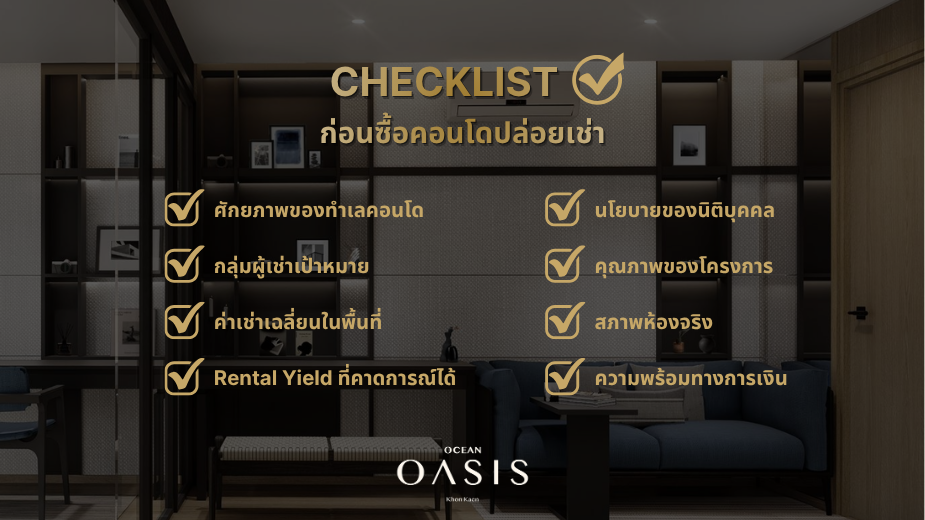
Before purchasing a condominium as an investment property, consider the following checklist:
Completing these steps before investing can significantly reduce risk and improve your chances of generating stable rental income over the long term.
For investors looking to diversify their portfolio beyond Bangkok into Khon Kaen real estate investment or Khon Kaen condo investment, Khon Kaen condo prices remain relatively affordable today, driven by the growth of universities, hospitals, and new infrastructure that continues to fuel housing demand in the city.
Areas surrounding Khon Kaen University and the city center remain in high rental demand, particularly among university students, medical professionals, and working professionals relocating to the province.
Successful condo rental investment today requires looking at the full picture—location, tenant profile, ownership costs, and real returns. Choosing a project that meets tenant needs from day one increases the chance of building stable cash flow over the long term.
For those looking for a Khon Kaen condo for investment, the condo near Khon Kaen University, Ocean Oasis Khon Kaen, is an attractive option thanks to its location close to Khon Kaen University, convenient access, and strong fit with genuine local rental demand.
The project also reflects the concept of a sustainable condo and low-rise condo development that prioritizes quality of life and long-term living—factors that help increase the potential for sustainable returns from rental condo investment in the future.
To learn more about Ocean Oasis Khon Kaen or arrange a private project viewing, please contact:
Q: What is condo rental investment?
A: Condo rental investment involves purchasing a condominium to generate recurring rental income while potentially benefiting from long-term property value appreciation. Before investing, buyers should evaluate important factors such as location, target tenants, operating costs, and expected Rental Yield.
Q: Is buying a condo for rental income a good investment?
A: It can be an excellent long-term investment for those seeking passive income and portfolio diversification. Condominiums located in areas with genuine rental demand—such as near universities, business districts, hospitals, or public transportation—typically enjoy stronger occupancy rates. However, investors should also prepare for vacancy periods, maintenance expenses, and tax obligations.
Q: Is renting out a condo on a monthly basis legal in Thailand?
A: Generally, yes. Leasing a condominium for one month or longer is typically permitted under Thai law and is not considered hotel operation under the Hotel Act. However, short-term rentals—such as daily or weekly stays offered through platforms like Airbnb—may be subject to legal restrictions if the property is not licensed as a hotel. Investors should also review the condominium’s juristic office regulations regarding short-term rentals before listing their unit.
Q: What are the advantages and disadvantages of investing in rental condos?
A: Advantages
Disadvantages
With careful financial planning, realistic return expectations, and the right property selection, condo rental investment can become a reliable source of passive income and long-term wealth creation.