
previous
Investing in Khon Kaen Condos: Rent, Locations & Yield

If you are looking for a house or a condo, you may have seen the term "EIA Approved" on project advertisements and wondered what EIA is.
In this article, Ocean Property will guide everyone through the meaning of EIA, Environmental Impact Assessment, the process of preparing an EIA report, and the reasons why you should check the EIA status of a project before deciding to buy or invest in real estate.
Key Takeaways

EIA (stands for Environmental Impact Assessment) is Environmental Impact Assessment, which is the process of studying and analyzing impacts that may arise from development projects or activities, both from the public and private sectors.
This assessment covers both positive and negative impacts that may occur on natural resources, the environment, health, quality of life, and surrounding communities in order to establish appropriate measures for prevention and mitigation before the project commences.
In simple terms, EIA is a crucial tool that helps development projects coexist with environmental conservation and the quality of life of the people.
Key Benefits of EIA
Thus, EIA is a legal requirement and a risk management tool for projects.
According to the Office of Natural Resources and Environmental Policy and Planning, the EIA report preparation covers 4 main areas of environmental study:
The EIA report must study changes in soil, water, air, noise, and vibration.
Study the potential impacts on biological resources and ecosystems surrounding the project, whether it be forests, vegetation, wildlife, aquatic animals, and the balance of the ecosystem, to assess how much the project will affect biodiversity and the existence of living things in the area, and to determine appropriate prevention or restoration measures.
Assess the human use of resources such as land use, transportation, and access to various resources.
Study the potential impacts on the quality of life of people in the area, both in terms of health, community, local economy, occupation, culture, and way of life, including surrounding scenery, to assess how the project will affect the livelihood and well-being of people in the area and find ways to mitigate impacts.
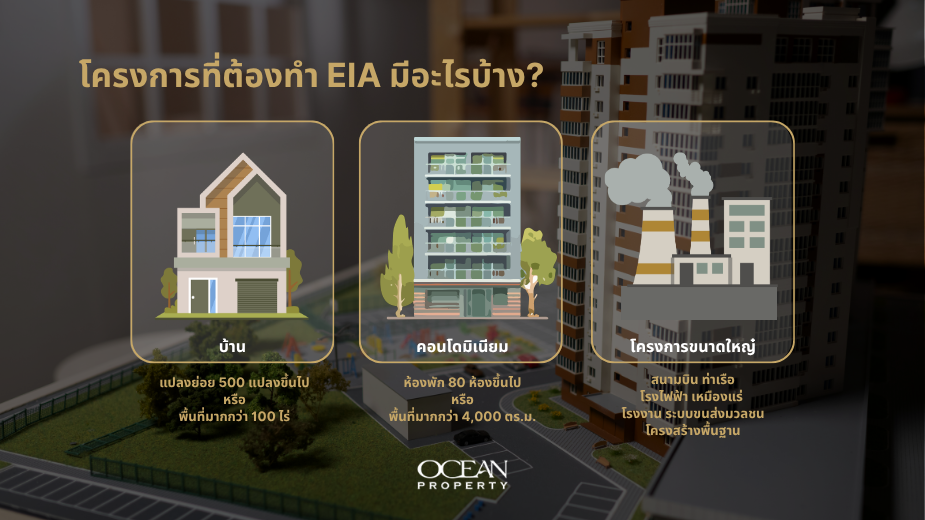
For housing projects with 500 or more plots or a project area exceeding 100 rai.
For condominium projects with 80 or more residential units or a total usable area of more than 4,000 square meters.
For other large-scale projects such as airports, seaports, power plants, large-scale mines, industrial factories, mass transit systems, and government infrastructure.
EIA Approved is the status that a project has received approval for its EIA report from the relevant authorities.
For real estate buyers, the term EIA Approved is considered a positive signal because it shows that the project has passed the environmental impact assessment based on criteria set by law. Many projects, therefore, use this term as a highlight to communicate with buyers and investors.
You can check the status through the Smart EIA Plus system on the website of the Office of Natural Resources and Environmental Policy and Planning (ONEP).
After the EIA report is approved and EIA Approval is granted, the project owner must still follow up according to the measures specified in the report.
This process is called EIA Monitoring or environmental impact monitoring, where an EIA Monitoring report is prepared to check whether the project complies with the specified measures and whether the actual impacts are as assessed.
If a project falls under the scope of the EIA law and is required to be assessed but does not undergo the process or does not receive EIA approval, it will not be permitted to be constructed and will not be granted a housing development license.
For real estate buyers, checking the EIA status is another important factor before making a purchase decision because it helps reduce legal risks and future project delays. Furthermore, EIA also reflects the project development standards.

For those looking for a condo in Khon Kaen, Ocean Property recommends Ocean Oasis Khon Kaen, a Low-Rise condo project designed to meet the needs of both living and future Khon Kaen Condo investment. A condo near Khon Kaen University on a potential location, situated near hospitals and major lifestyle hubs of the city.
Ocean Oasis Khon Kaen stands out with the Urban Living with Nature concept, perfectly blending city living with nature.
The project is fully equipped with facilities that cater to every lifestyle, whether it is a Half-Olympic salt-water swimming pool, Co-Working Space, Sky Bridge, Sky Open-Air Gym, and Smart Access Control system for the convenience and safety of residents. Furthermore, the project strictly operates according to environmental requirements and has received EIA approval, giving buyers confidence whether buying for self-living or buying for real estate investment in Khon Kaen, such as renting out.
Q: What is EIA?
A: EIA, or Environmental Impact Assessment, is an assessment that may arise from various development projects to define measures to prevent and mitigate impacts on the environment and community.
Q: What does EIA stand for?
A: EIA stands for Environmental Impact Assessment.
Q: What is EIA Approved?
A: EIA Approved means the project has received approval for the EIA report from the relevant authorities and can proceed with the construction permit application process.
Q: What is EIA Monitoring?
A: EIA Monitoring is the tracking and inspection of environmental impacts after a project has been approved to ensure compliance with the measures specified in the EIA report.
Q: Do all condo projects require an EIA?
A: Not necessarily every project. Condos that require EIA must have 80 or more residential units or a total usable area of 4,000 square meters or more as prescribed by law.
Q: What is EHIA?
A: EHIA is Environmental Health Impact Assessment or Environmental Impact Assessment and health, used for projects that may have severe impacts on the community and public health.
Q: Where can I check the EIA status of a project?
A: You can check through the Smart EIA Plus system on the website of the Office of Natural Resources and Environmental Policy and Planning (ONEP), which is the agency responsible for considering EIA reports in Thailand.